Victoria’s circular jobs boom is coming – but are we ready?

Shifting to a circular economy will create jobs with higher salaries for Victorians. Sustainability Victoria’s new research reveals clear opportunities to strengthen Victoria’s workforce readiness to ensure workers are well placed to reap the benefits of a circular economy.
The case for circularity
Moving from a linear take-make-waste model to a circular economy requires more than just a shift in how we use materials. The industries, professions and supply chains that form our economy need to pivot to eliminate waste, reduce emissions and sever the link between economic growth and use of finite resources.
Victoria’s shift to a circular economy will generate jobs, attract investment, increase productivity and strengthen our competitive advantage. Modelling shows a circular economy could increase Australia’s GDP by $26 billion in the next 10 years and add 150,000 new jobs to the Australian market by 2048.
The first report of its kind, Circular Jobs and Skills: Planning for our Future, helps define the education, skills and occupations required to effectively transition Victoria's workforce to a circular economy.
Jobs of the future
Circular jobs are essential for Victoria’s transition to net-zero and a clean circular economy.
In 2023, Victoria’s circularity rate was 7.5%. This is higher than the Australian rate of 4.4%, but increasing our state’s circularity will take deliberate intervention.
Circular Jobs and Skills: Planning for our Future provides the evidence base for government action, analysing each area of the economy and identifying the 87 sectors that will contribute most to a circular economy.
Circularity means high salaries and ample opportunity
Our findings indicate the transition to a circular economy will create jobs with higher salaries.
Further, circular jobs won’t replace existing jobs but will offer new opportunities for both highly educated and lower-skilled Victorians.
The jobs that will be in higher demand in our future circular economy are:
- Design, engineering, science and transport professionals
- Automotive and engineering trades workers
- Technicians and trades workers
- Specialist managers
- Electrotechnology and telecommunications trades workers
- Business, human resource and marketing professionals.
Instead of existing jobs disappearing, occupations may need to pivot to contribute to circular outcomes. For example, an architect could shift from designing non-circular buildings to designing dwellings that allow for repair, flexibility, and the use of sustainable materials.
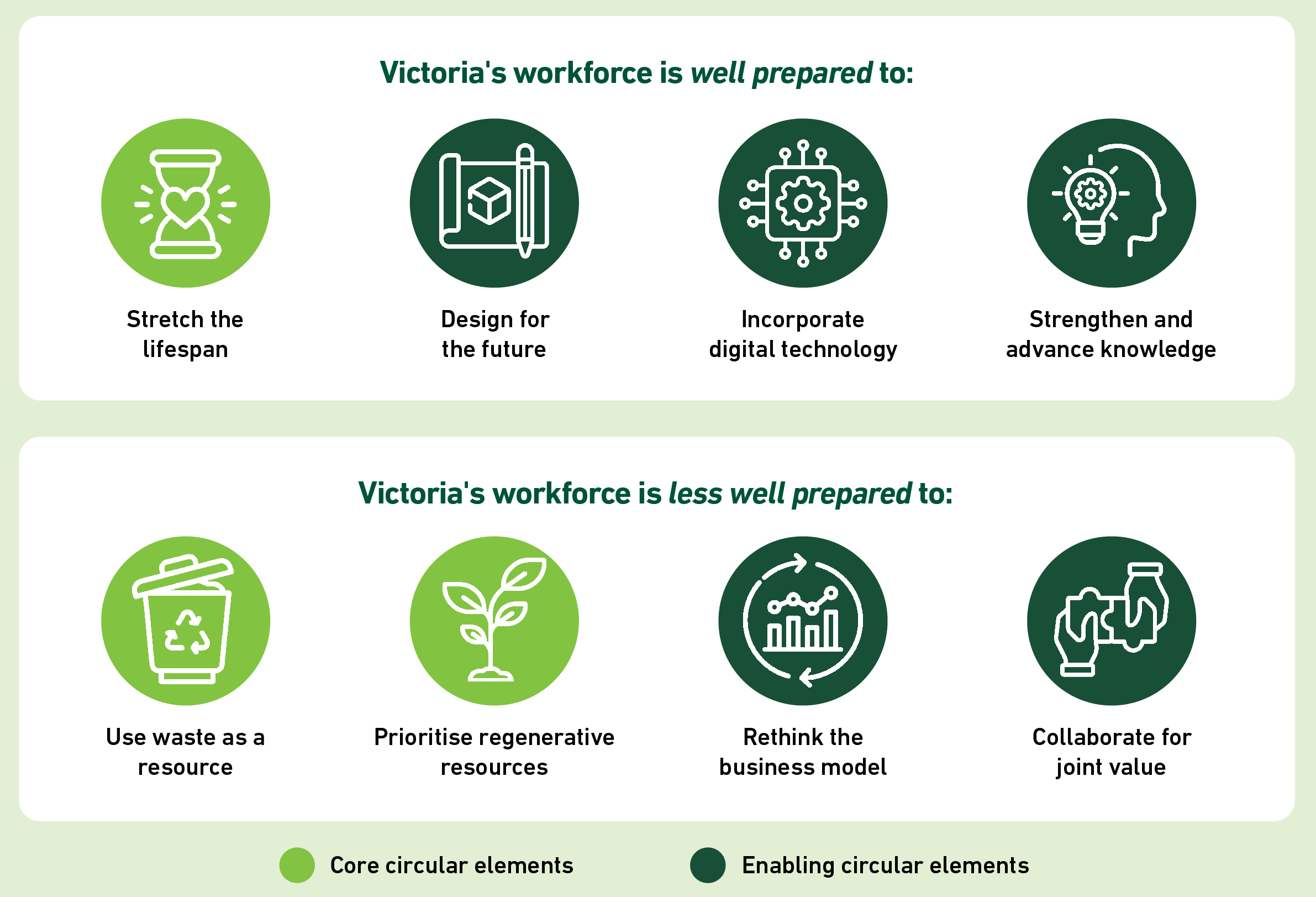
Victoria is only partially prepared for circularity
Victoria’s workforce has many of the capabilities needed for a circular economy, but they need to be applied strategically to achieve circular outcomes.
Victoria’s comparative advantages in terms of workforce preparedness could help position us strategically within a broader national and international circular economy.
Sustainability Victoria’s research includes detailed capability profiles for each element of the circular economy. These profiles highlight the varying levels of workforce preparedness and where further intervention may be required.
Research vital for workforce planning
The findings can be used to support policy development, workforce initiatives and economic development activities undertaken by government, industry and educational institutions.
Sustainability Victoria is providing research insights directly to Melbourne Polytechnic, helping to set Victorian students up for success in the circular economy.